Data & Industrial IT

Industrial IT that makes production data usable

Industrial informatics connects OT systems with higher-level IT such as ERP, MES or cloud platforms. At cts Group it grew out of hands-on integration work: what began in 2009 with individual interface projects and our own OT software for alarm management and controller monitoring has been a separate business unit since 2017. Today our industrial IT team handles OT/IT integration from consulting and infrastructure to applications.

How we make data usable

Seven services from the controller to the dashboard

Application Framework for process data: configure applications instead of programming them.
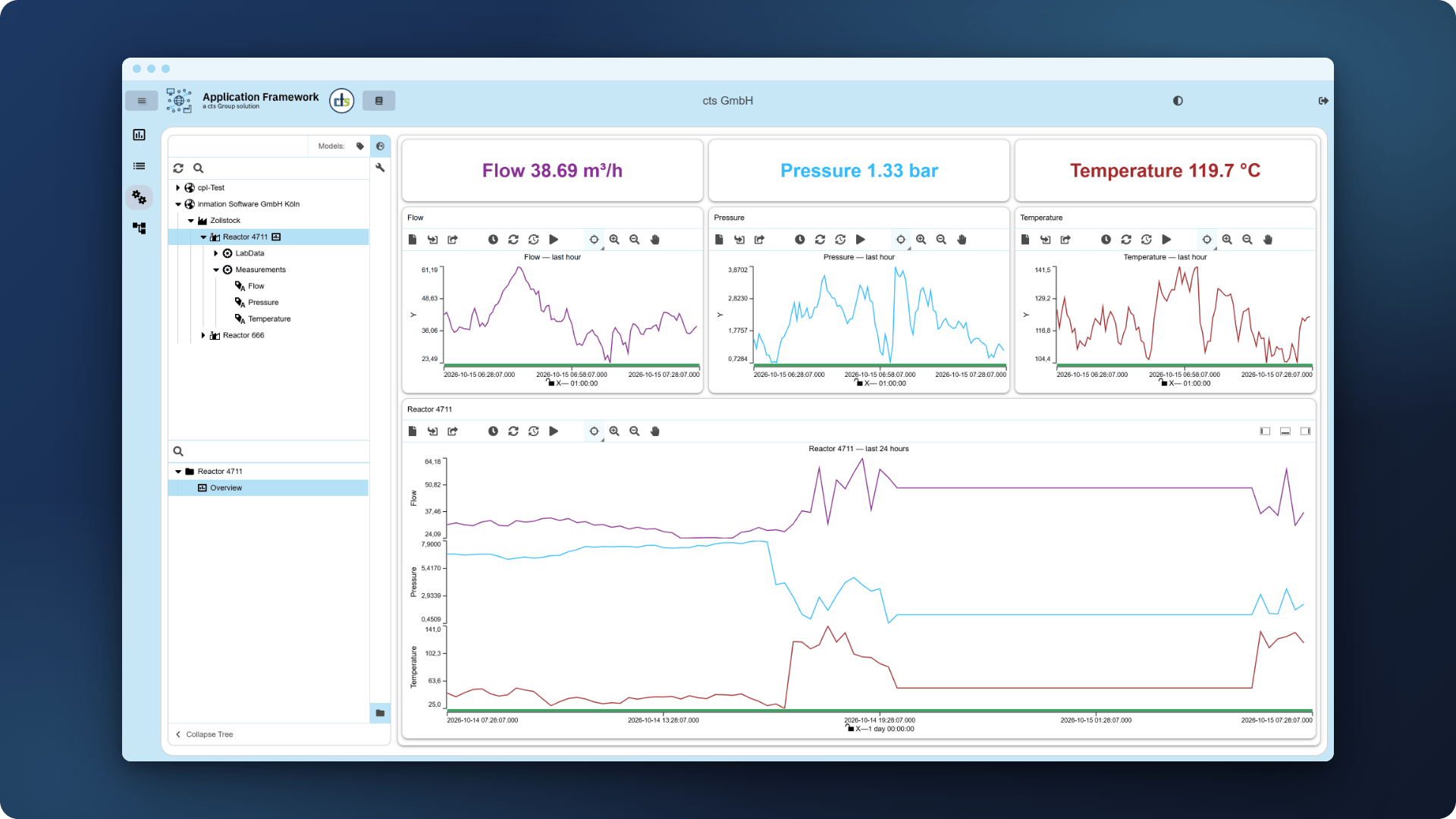
The cts Application Framework is an application layer on top of AspenTech Inmation WebStudio. Your team assembles applications and dashboards from ready-made modules; a consistent interface, roles and permissions, and documentation are built in from the start.

  • Trending time series from inmation, curves and axes set up without code
  • Events filter and sort events and messages
  • OPC Browser create only the OPC DA items you actually need
  • Compilations your own dashboards on the equipment object, with approval
Data analysis and visualization: putting raw technical data into context.

We capture raw data across vendors and put it into context with AspenTech Inmation. Process data becomes KPIs, reports and dashboards that production and quality can rely on.

  • Central monitoring and alarm management
  • Batch analysis and quality reviews
  • Compliance, audit trail and audit-proof archiving
  • KPI dashboards and advanced data visualization
  • Industrial analytics and dashboarding

Data management: structuring, orchestrating and securing industrial data streams for the long term.

We build data infrastructures that break down silos: from connecting systems such as AVEVA PI, IP.21 or SAP to SQL and NoSQL architectures, with traceability across the entire lifecycle, including GxP environments.

  • Industrial data integration
  • Complex data architectures
  • Connectivity and cloud gateways

Connectivity and interfaces: data from the sensor to the ERP.

We connect control and process control systems to MES and ERP, independent of vendor, using standards such as OPC UA and MQTT. Equipment of different generations becomes part of one continuous data landscape.

  • Batch data management and tracking
  • Laboratory information systems
  • SIMATIC Batch integration
  • Vertical integration from the sensor to the ERP
  • Industrial connectivity and OPC support

OT/IT infrastructure consulting: planning the architecture before you invest.

We assess your existing infrastructure and plan the path to a vendor-independent industrial data fabric: from the as-is analysis and technology selection to the value chain analysis.

  • Your path to an industrial data fabric
  • Value chain analysis
  • Modernizing and integrating legacy systems
  • System modernization and data migration

OT/IT infrastructure engineering: building and running high-availability systems.

We implement server, virtualization and network infrastructures for production and keep them operational across their entire lifecycle, including cyber security to IEC 62443.

  • Preserving and migrating legacy systems
  • Backend, database and network engineering
  • Reverse engineering and system reconstruction
  • Low-level software development
  • Cyber security
  • System modernization and data migration

Custom software solutions: closing gaps in OT with our own software.

When standard software does not fit, we develop our own. With mularis, our modular platform for digitalizing industrial processes, we map processes such as work permits digitally.

  • mularis digital process anagement on one platform
  • Electronic permit to work
  • Digital shift log

Partners for platforms and consulting

We work with the vendors of the data platforms we introduce at customers, and with consulting partners who bring experience from regulated industries. Together we cover projects from strategy to operation.

Partners
  • Con2Scale
  • Xenium
  • AspenTech
  • AVEVA
  • Vester Business & vNode

What you can expect from us

  • OT and IT in one team

    Since 2009 we have been connecting controllers and process control systems with corporate IT. Consulting, infrastructure, integration and software stay with one team that knows both worlds.

  • Technology that fits your architecture

    We work with AspenTech Inmation, AVEVA PI and other platforms and choose the technology to fit your existing landscape, not a vendor.

  • Experience in regulated environments

    In GxP environments we plan data integrity, audit trail and validation from the start, so your data also holds up in an audit.

Customers talk about their projects

  • A live research platform for direct air capture

    How TU Wien built a live platform for its direct air capture research together with cts. A postdoctoral researcher at TU Wien talks about two and a half years of collaboration.

    Language: English · Watch on YouTube ›

  • Materiallager direkt an der SMT-Linie

    Ein Abteilungsleiter von Bender berichtet, wie cts OCTA Storage als kompaktes Lager in Produktionsnähe den Suchaufwand senkt und Bestände sichtbar macht.

    Sprache: Deutsch · Auf YouTube ansehen ›

  • Sondermaschine für orthopädisches Material

    Wie automatisiert man die Herstellung von orthopädischem Therapiematerial? Julius Zorn und cts zeigen das Projekt.

    Sprache: Deutsch · Auf YouTube ansehen ›

  • Automatisierter Materialfluss bei Siemens

    Rundgang durch die #factory2be in Karlsruhe: cts CUBE Storage, angebunden über AMRs mit Top-Modulen von cts.

    Sprache: - · Auf YouTube ansehen ›

Die Videos werden erst nach Ihrem Klick von YouTube geladen. Dabei gelten die Datenschutzbestimmungen von Google.

Ob eine Fertigung zuverlässig liefert, entscheidet sich selten an einer einzelnen Maschine. Es hängt davon ab, wie Lager, Materialfluss, Anlagen und Service zusammenspielen und welche Investition sich zu welchem Zeitpunkt lohnt. In unseren Gesprächen ordnen Fachleute der cts und unserer Partner solche Fragen aus ihren Projekten ein: mit Beispielen aus realen Fertigungen.

Experts in conversation

Whether data is actually used in operations is rarely decided by the platform alone. It depends on which data is needed, how OT and IT work together and whether everyone involved supports the project. In our conversations, specialists from cts and our partners discuss these questions from their own projects: with examples from real plants and with what works in practice and what does not.

  • Industrial data fabric in pharma: the full conversation

    The complete episode with cts and our partner Xenium that the short clips above come from. Just over an hour and a half on industrial data fabric in pharmaceutical production.

    Language: English · Watch on YouTube ›

  • Why projects that start with the IT system fail

    Choosing the system before use cases, data priorities and organization are clear leads to failure. What needs to be settled first: which data matters, at what quality and which team runs it.

    Language: English · Watch on YouTube ›

  • Industrial data fabric or historian?

    Florian Seidl (cts Group) explains the difference: enterprise-wide instead of per plant, centrally configured, with security planned into the architecture. And why you can still start with quick wins such as data for predictive maintenance.

    Language: English · Watch on YouTube ›

  • Change management: why trust decides

    Florian Werner (Xenium) on the success factors: a strategic foundation, management buy-in, cross-functional teams and change management that starts early. The organization is often harder than the technology.

    Language: English · Watch on YouTube ›

  • Which data matters? Assess before you build a platform

    Florian Seidl (cts Group) and Florian Werner (Xenium) on what to clarify before choosing a platform: data landscape, data quality, units and aggregation, ownership and the data lifecycle.

    Language: English · Watch on YouTube ›

  • Pharma: connecting systems from many vendors

    Pharma rarely has one central control system as in chemicals or oil and gas, but equipment from many vendors that was never built to share data. Why an industrial data fabric is the foundation here.

    Language: English · Watch on YouTube ›

Latest articles on industrial IT

Our specialists write about experience from integration projects: what works in practice, where the typical pitfalls are and how industrial data fabric and OT/IT integration can be implemented. Here are the latest articles.

Smiling man in circular frame beside digital charts with text “cts Application Framework” and “How available data becomes usable.”
By Florian Seidl • October 16, 2026
Available data is not usable data. Why the application layer decides whether a data project pays off – and who is allowed to build a view.
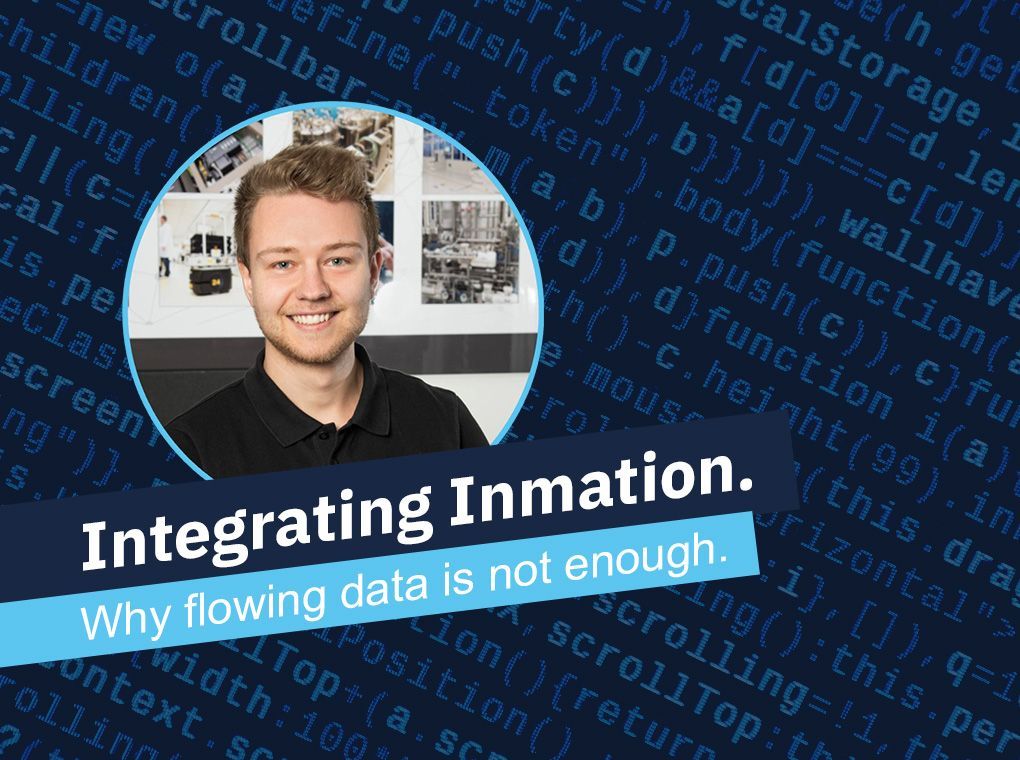
Portrait in a circular frame over a blue code background with text: “Integrating Inmation. Why flowing data is not enough.”
By Clemens Schadner • October 16, 2026
The data flows, the project is signed off – and production still uses Excel. Why this gap appears systematically, and where the project boundary sits.
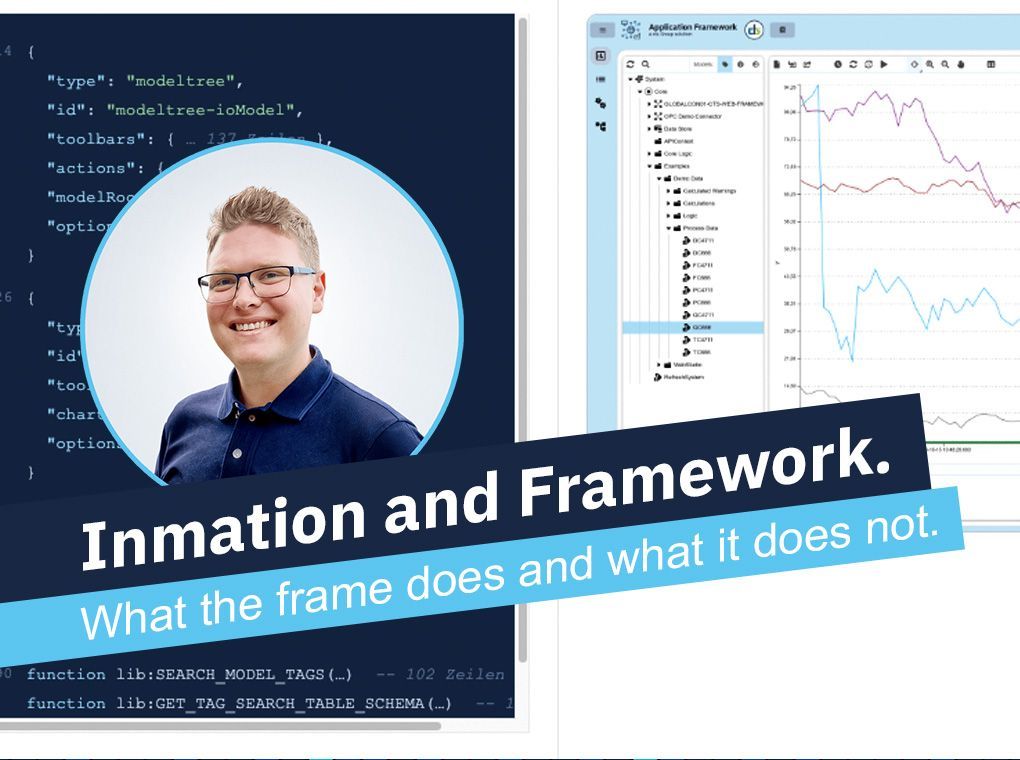
Presentation slide with portrait, code, charts, and title “Information and Framework” on blue banner
By David Denk • October 16, 2026
What can the framework do that Inmation cannot? Why the question matters – and which question actually decides it in operations.
View more articles

Frequently asked questions about industrial IT

  • What is industrial IT?

    Industrial IT connects automation and information technology. It makes sure that data from controllers, process control systems and laboratories is captured, structured and made usable for production, quality and business systems such as MES and ERP. At cts Group this covers consulting, infrastructure, data integration and our own software. Read more in our article “Smart data: How cts networks industrial processes”.

  • What is AspenTech Inmation?

    AspenTech Inmation is software for industrial data management. It connects controllers, historians, databases and cloud services, puts the data into context in a unified namespace and makes it available across the company for analytics, from a single plant to a rollout across all sites. AspenTech has been part of Emerson since March 2025. As an AspenTech partner, we implement inmation at customer sites. Read more in our article “What is inmation?”.

  • What is an industrial data fabric, and how does it differ from a historian?

    A historian stores time series from a plant. An industrial data fabric connects data from OT and IT across all sites, is configured centrally and provides the data with its context, for example by asset, batch or product. Existing historians often remain in place as data sources. AspenTech Inmation is a platform for this kind of industrial data fabric. Read more in our article “Industrial Data Fabric – What It Is and What It Really Offers”.

  • What is inmation WebStudio, and what does the cts Application Framework add?

    WebStudio is the AspenTech Inmation interface in which views are assembled from widgets. These views are called compilations. The cts Application Framework adds an application layer on top: ready-made modules for time series, events, OPC data points and custom dashboards, plus a consistent interface, roles and permissions, and the matching documentation for every module. Your team configures applications instead of programming them. It requires WebStudio version 1.96.2 or later. Read more in our article “cts Application Framework: How available data becomes usable applications”.

  • What is a unified namespace?

    A unified namespace (UNS) is a shared data space where all systems publish and retrieve their data in one consistent structure, for example following ISA-95 from enterprise via site, area and line down to the cell. Instead of many point-to-point connections, each system only talks to this data space. Read more in our article “Industrial data contextualization”.

  • Which platforms and interfaces do you work with?

    Among others, we work with AspenTech Inmation and AVEVA PI, connect systems such as IP.21, SIMATIC Batch or laboratory systems, and use standards such as OPC UA, OPC DA and MQTT. For analysis we use tools such as Power BI or Tableau. Which platform fits depends on your existing landscape. Read more in our article “How production data from different systems is consolidated”.

  • How does cts support GxP requirements?

    In regulated environments we plan data integrity according to ALCOA+, audit trail and audit-proof archiving from the start and support the validation of the systems. This keeps data traceable from the sensor to the batch report. Read more in our article “GxP-compliant and still usable”.