


Industrial Data Contextualization: Why Raw OT Data Fails — and How to Fix It
Why the next competitive frontier in industrial manufacturing is not collecting more data — but giving it meaning at the point of capture.
In the global discourse surrounding OT integrations — DCS, PLC, SCADA systems — and the broader Industrial Internet of Things (IIoT), we have spent more than a decade focused on the act of connectivity. We celebrated the technical milestone of pulling a signal from a sensor and landing it in a cloud database. That was necessary. But it was never sufficient.
As we navigate 2026, the industrial sector has reached a critical plateau. The challenge facing modern manufacturing is no longer a scarcity of data — it is what we call the Semantic Gap: the profound disconnect between the technical process value and its operational meaning. Many organizations — particularly those approaching the problem from a cloud-first perspective — are data rich but insight poor. Closing this gap is the only path from reactive monitoring to true decision intelligence. For teams already embedded at the data-producing interfaces — at the PLC, the DCS, the historian — this gap looks different, but it does not disappear.
Why OT Data Without Context Is Worthless: The Semantic Gap in Manufacturing
In high-tech production environments, the field level and shop floor generate millions of technical raw data points every second. Yet across the industry, a consistent pattern emerges: companies have expanded their data collection capabilities dramatically over the last five years — while the share of that data actually used for downstream decision-making remains stubbornly small. The culprit is not a lack of storage. It is a lack of structure.
Technical raw data, stripped of its process context, is inherently silent.
"A temperature reading of 85°C, isolated in a PLC register, is a meaningless fragment. It only matures into Decision Intelligence when it is semantically mapped to a specific asset, a running process phase, and a unique production batch."
Without this logical connection, we are not building a foundation for AI or analytics. We are creating Data Swamps — expensive digital graveyards where information is deposited but never retrieved. At cts, our view is clear: for data to be decision-ready, it must be captured and integrated under a unified architectural logic that bridges the gap between the shop floor and the executive suite.
Industrial Data Fabric vs. Data Lake: Why Manufacturing Needs More Than Storage
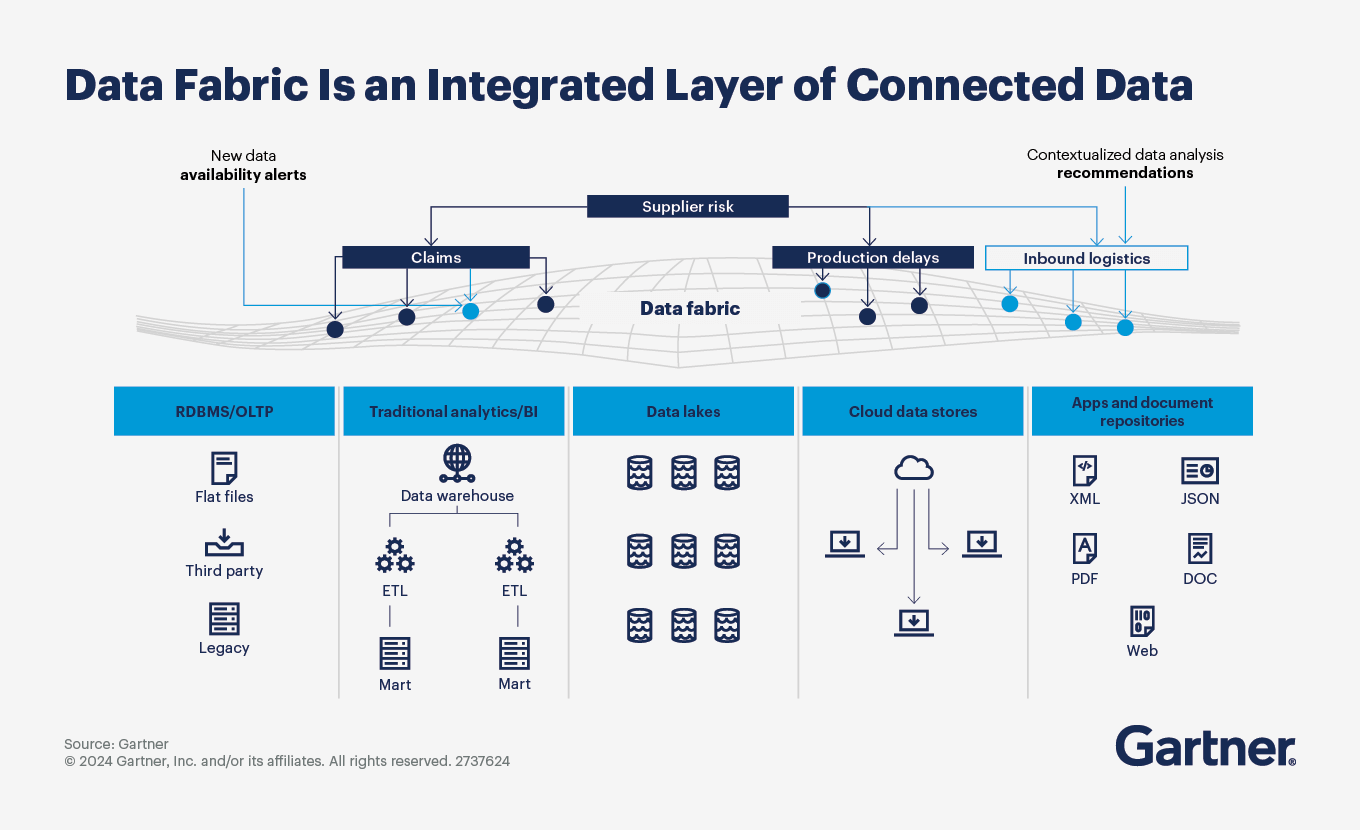
To address this fragmentation, we have refined a strategic framework centered on the Industrial Data Fabric (IDF) — primarily utilizing AspenTech Inmation as the orchestration layer. Unlike traditional Data Lakes, data warehouses, or other point-to-point integration approaches that often lack governance, an IDF acts as a horizontal, manufacturer-independent platform that creates a Digital Twin of the data itself.
According to Gartner, Data Fabric architectures are a top strategic priority precisely because they can reduce data management effort by up to 70% by automating the integration of disparate sources. When different platforms and approaches exist for implementing a Data Fabric, a key question becomes practical: why do it the hard way, when there is an easy one? That is exactly the case for AspenTech Inmation — an architecture that removes the need for brittle custom integrations without sacrificing governance or scalability.
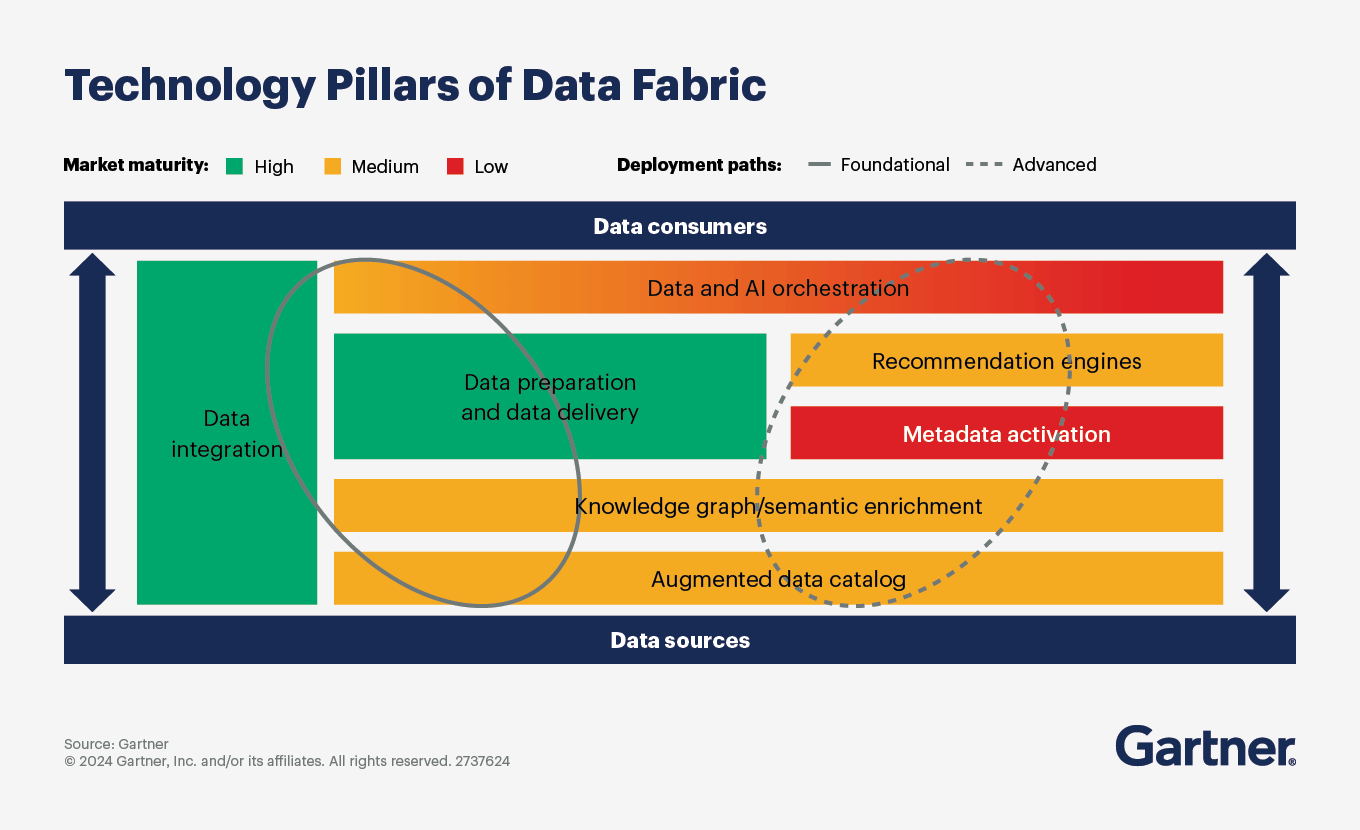
Our approach at cts focuses on dissolving data silos by creating a through-line from the sensor to the ERP level. By normalizing heterogeneous data from specialized systems — such as AVEVA PI, AspenTech IP.21, or lab-specific platforms like Mettler Toledo LabX — we provide a single, reliable basis for facts. This is not merely a technical integration. It is a structural transformation that enables something often overlooked: data exchange and information flow within the same ecosystem — including to and from control systems like DCS and PLC — that would otherwise be impossible or prohibitively complex through any other path.
When data is contextualized at the point of ingestion, the effort required for compliance and audit-trailing drops significantly. The system provides a seamless, tamper-proof record by design — a single source of knowledge, not just a single source of storage.
From Reactive Monitoring to Industrial Analytics: The Data Maturity Curve
The ultimate goal of this architectural shift is to move the enterprise up the maturity curve. At cts, we use modern tools like Power BI and Industrial Analytics not just to see what happened yesterday — but to understand what is happening right now and what will likely happen tomorrow.
This requires treating the Industrial Data Fabric as a secure, scalable solution that protects against external threats while remaining open enough to support global rollouts. Industry research consistently shows that manufacturing leaders who master data contextualization see measurable reductions in quality-related costs and a significant boost in OEE (Overall Equipment Effectiveness). The organizations achieving those results are not doing so through better software licenses — they are doing it through better data structures.
At cts, we draw on hands-on practice to ensure that this digital transformation is not just an IT project. It is an operational reality that understands the realities and nuances of the plant floor.
What Industrial Leaders Need to Know About Data-Driven Manufacturing
The transition to a data-driven enterprise is more than an engineering challenge — it demands organizational alignment, management buy-in, and a clear strategic narrative that speaks to business leaders, not just automation specialists. Context is King is the first installment of a series that examines the different dimensions of this transformation. Future posts will address architecture decisions, change management, and the organizational structures that make these platforms scale.
The competitive advantage in the years ahead will not belong to the organization with the most sensors. It will belong to the one that can translate those signals into a transparent, real-time narrative of their production — accessible and actionable at every level of the organization. Context is not just a technical feature. It is the king of the modern industrial economy.
Ready to close your Semantic Gap?
Talk to our Industrial Informatics team at cts Group — we work with you from the sensor to the boardroom.