


Material flow —the central nervous system of electronics manufacturing
Why the SMT line alone does not determine competitiveness
“We need a standard solution.” You hear this phrase often, but in the reality of electronics manufacturing, the “standard” is an illusion. By its very nature, every production facility has its own bottlenecks, every assembly line its own peculiarities, and every material flow its own historically accumulated pitfalls. Anyone who tries to impose rigid concepts on individual processes creates friction and inefficiency.
In the run-up to his presentation at the EPP Innovation Forum, Josef Höving dispels the wishful thinking behind “off-the-shelf automation.” He explains how companies can systematically navigate the path from manual processes to full automation – without overlooking the realities of their own manufacturing operations. A conversation about real-world challenges, the fear of complexity, and the courage to embrace individual scalability.

The Architecture of Flow: Strategy Before Hardware
cts: Josef, many providers promise standard solutions. You and the cts Group say, “Every manufacturing operation is different.” Why is trying to force customers into a standard approach often the first step toward the failure of an automation project?
Josef: In our discussions with customers, we repeatedly find that the reality on the factory floor rarely matches the theoretical ideal. Very few production facilities were planned from scratch last year; instead, most sites have grown organically over decades and have been continuously expanded. In such existing facilities, we encounter components like loaders and unloaders that were never intended for automation, or numerous manual workstations where material supply cannot be easily handled by simple standard AGVs. Even structural features such as steps in the floor between different sections can become obstacles. Anyone who tries to impose a rigid, standard solution here ignores these individual hurdles. Our approach is therefore to develop systems that are close to standard but
individually configurable, which integrate seamlessly into the existing infrastructure and intelligently incorporate existing legacy systems.
cts: When you walk into a manufacturing facility that’s still heavily reliant on manual labor – what are the typical “signs” that decision-makers themselves often no longer even notice, because they’ve grown accustomed to the environment and the obstacles that may have developed along with it?
Josef: It is always revealing to observe how and where boxes, trays, SMT reels, or PCB magazines are temporarily stored. Often, these items are scattered throughout the entire production area or split up in inconvenient locations due to a lack of space. Another clear sign of potential for optimization is empty containers, which frequently block traffic routes in the production area. These established structures lead to a disrupted material flow and unnecessary search times, which are often accepted as “normal” in the stressful day-to-day of production.
cts: The biggest concern during the transition is often: “If we automate and the system goes down, everything comes to a standstill.” How do you help customers overcome this psychological hurdle?
Josef: This concern is entirely understandable, which is why we incorporate it as a key factor into our planning from the very beginning. Fundamentally, all of our systems – whether they are automated storage solutions (CUBE Storage, OCTA Storage, REEL Storage, REEL Tower) or autonomous mobile robots (AMRs) – are designed to ensure safe and stable operation for many years to come. We also address the risk of downtime with a two-tier safety net: On the one hand, we ensure through customized service and maintenance contracts that response times remain minimal in the event of an emergency and that the availability of your system remains consistently high. On the other hand, we take care to maintain process stability during the design phase. In many production areas, we therefore plan workflows so that transport processes can still be carried out manually in an emergency, ensuring that production remains operational at all times.
The Roadmap: A Structured Approach from 0 to 100
cts: At the EPP Innovation Forum, you’re using a diagram on full automation. What’s the first logical step when transitioning from a manual process? Why is it a mistake to do the second step before the first?
Josef: A key factor in the success of any automation project – whether in intralogistics or other production areas – is actively involving employees in the planning process from the very beginning and ensuring they are on board with the initiative. From a technical standpoint, we ideally begin redesigning the material flow with a dedicated standalone solution, which we often offer our customers on a loan basis even before the actual order is placed.
It would be a strategic mistake to put the cart before the horse and implement a highly complex end-to-end system without this learning phase, as acceptance and process stability take time. Instead, we integrate one station at a time and gradually expand the system with additional components such as our seamless intralogistics solutions. This path to full implementation is designed to be modular and scalable and can – in the spirit of sustainable development – spans several years.
cts: Can partial automation (e.g., using just one OCTA STORAGE on a line) exacerbate new bottlenecks elsewhere if you don’t keep the entire system in mind, or does it actually make sense to automate step by step so as not to lose sight of the big picture?
Josef: A thorough analysis of existing processes is the key to any successful automation project. Without a precise assessment of transport routes and cycle times, we risk creating bottlenecks along transport routes, in front of warehouses, or at manual workstations. In such a scenario, the promise of providing “the right material at the right place at the right time” can no longer be fulfilled, thereby negating the actual benefit of the investment. A phased implementation – for example, using a OCTA Storage as a scalable buffer solution near the production line – is nevertheless highly advisable. However, the key factor here is vendor-neutral integration into the overarching material flow and IT middleware to ensure that every component interacts optimally with the overall system and enables genuine efficiency gains.
cts: In practice, where do the greatest inefficiencies lie in the transition from manual labor to machine precision – both technically and organizationally?
Josef: Friction losses in projects usually arise when not all stakeholders are involved early on or when details are overlooked during the complex planning phase. Real-world situations often hold surprises that aren’t reflected in any diagrams: These range from a Wi-Fi network that isn’t stable enough to meet the new requirements to structural pitfalls such as underfloor heating that suddenly turns into a “fountain” when a system is anchored in place. This also includes damaged floors that were hidden under storage bins during the initial site inspection, or interfaces with the ERP/MES system that turn out to be more extensive than anticipated as the project progresses. However, what is crucial for the project’s success is not the absence of such issues, but rather how they are handled.
We place great importance on addressing such unexpected challenges as quickly as possible in collaboration with the customer to avoid delays and ensure seamless integration into the existing production environment.
Flexibility as a competitive advantage in times of economic challenges
cts: cts develops custom-built special-purpose machines. How do you manage to tailor your global solutions to specific needs time and again without having to reinvent the wheel every time (keyword: near-standard configuration)?
Josef: Because we have been developing our own solutions for many years, we now have an extensive and technologically mature portfolio of existing systems. We continuously review and optimize this portfolio to tailor it precisely to our customers’ requirements without having to start from scratch on every project. Another key factor in our success is our long-standing, collaborative relationships with suppliers. Through this close cooperation, we ensure that mechanical and electrical interfaces remain close to industry standards and do not become unnecessarily complicated. The result is future-proof and scalable solutions that are individually configured but based on proven standards.
cts: From SMT reels to KLTs, boxes and totes to specialized trays. How can we ensure that today’s equipment can handle the components of tomorrow – components we don’t even know about yet?
Josef: The answer lies in the consistent modularity of our systems. Our transport modules and storage units are designed to function not as rigid units, but as adaptable platforms. Should requirements regarding component dimensions or load carriers change significantly in the future, our modular concept offers the necessary flexibility: The AMRs can be adapted to new tasks. Such modifications are also possible for the storage systems at a reasonable cost. This approach guarantees our customers a high level of investment security, as the automation solution can grow alongside the technological leaps in electronics manufacturing. We can ensure adaptability because we don’t just integrate – we offer everything from a single source, from metal fabrication and design through to commissioning and automation.
cts: Middleware plays a central role in this. Is software the tool that makes the variability of hardware manageable in the first place?
Josef: Absolutely. A key advantage of automated intralogistics is the greater transparency it provides in the overarching ERP and MES systems. Seamless traceability across all production steps is now a standard requirement of our customers and is virtually impossible to achieve without powerful middleware.
While recurring tasks, such as transporting goods from the receiving area to the warehouse, can theoretically be triggered manually, without a comprehensive IT integration, crucial information is missing:
- When and where exactly is which material needed?
- Which material is located where and when?
Our middleware is designed as a modular system. After the initial joint installation, we provide our customers with such extensive training that they can independently implement future changes or new requirements within the system. This fosters independence and prevents unnecessary costs or delays when stations or routes need to be flexibly adjusted.
Bringing real challenges to light
cts: Hardly any factory is a “greenfield” facility. How do you integrate modern AMRs and warehouse systems into historically developed, cramped warehouse layouts?
Josef: This is indeed one of the most exciting challenges in planning. Interestingly, automation often even frees up valuable space, since containers and materials are stored centrally in a compact storage instead of cluttering the shop floor. Existing manual workstations can often be repositioned as part of this process to optimize material flow. For bottlenecks that cannot be resolved through structural changes, we define “one-way streets” in the control system so that the AMRs do not obstruct one another. Another crucial factor for smooth operation in confined spaces is raising employee awareness: the system can only achieve its full efficiency if the travel paths are consistently kept clear.
cts: We often talk about the precision of machines. But where is the human element still unbeatable in the process – and how do we design systems and integrate technologies like AMRs in such a way that they support people rather than hinder them?
Josef: There are manual processes that simply cannot be meaningfully automated today because humans possess unmatched speed and dexterity when dealing with constantly changing workflows. A classic example is goods receiving: An employee receives materials in an endless variety of boxes, pallets, and crates. They must open these without damaging the contents and receive the goods – a task that currently cannot be solved by machines at a reasonable cost. This is precisely where the strength of automation comes into play: As soon as the material is recorded, the system determines the destination and an AMR takes over the automated transport to the various storage locations – whether for SMT reels, circuit boards, sticks, or THT components. We design our systems so that technology frees people from monotonous transport tasks, allowing them to apply their cognitive and motor skills where they offer the greatest value.
cts: Business decision-makers ask about ROI. How does the calculation change when you factor in not only the reallocation of labor but also process stability and reproducibility?
Josef: The most obvious part of the ROI naturally stems from reduced staffing requirements. But the calculation goes much further today: We must take into account factors such as the acute shortage of skilled workers and the general availability of staff, as well as rising customer expectations that aim to limit manual processes to an absolute minimum. Most of our customers can quantify very precisely the enormous costs of downtime resulting from human error, absences due to illness, or simply lost materials.
Another often underestimated financial advantage is the newfound flexibility in scheduling: Automated systems make it possible to shift parts of production to unmanned night shifts or weekends without incurring the overhead costs associated with traditional shift models.
Outlook & EPP Innovation Forum
cts: Without giving too much away: What “aha moment” do you want to convey to the audience in your presentation using the diagram?
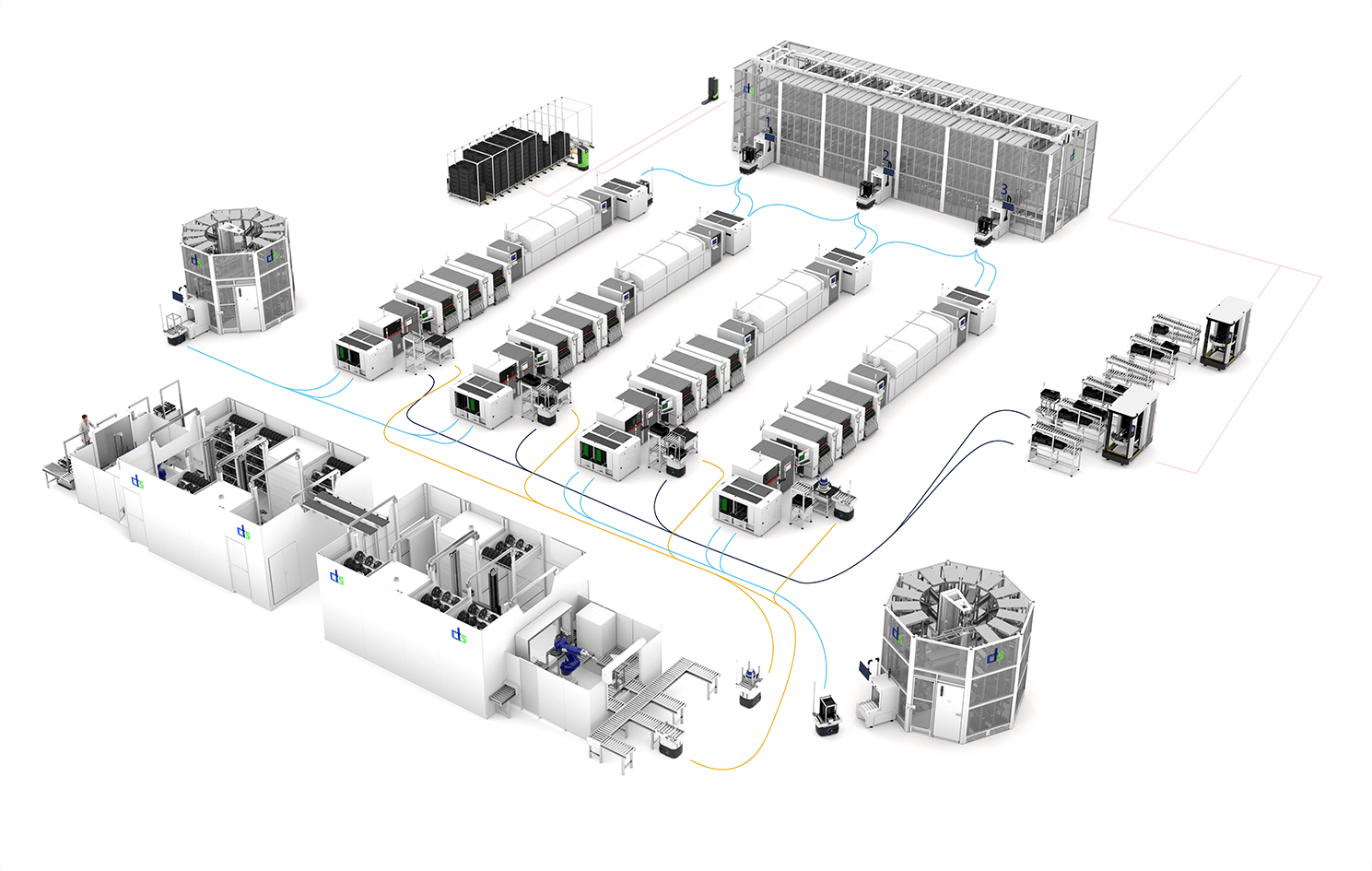
Josef: The key “aha moment” for many visitors is the realization that automation doesn’t have to be a rigid “all-or-nothing” process. There is often a prevailing belief that an entire facility must be retrofitted all at once to achieve greater efficiency. In the diagram, I want to show that the opposite is true: The real leverage lies in the intelligent interconnection of existing manual workstations through flexible, modular components such as our Smart Warehouses or AMRs. Participants should understand that it is not the maximum amount of technology, but rather the seamless communication between people, machines, and software via our middleware that drives the real leap in productivity. My goal is that, after the presentation, they will no longer see only obstacles in their established manufacturing operations in their mind’s eye, but rather the clear, automatable paths between them that we can explore together, step by step.
cts: Let’s conclude by discussing the evolution beyond automation. Suppose a company has reached the stage of full automation – material flow is smooth, and the warehouses are integrated. Does that mean the project is complete, or is that just the beginning of the next level of manufacturing intelligence? Will the future be about “self-healing” production that identifies bottlenecks before they arise?
Josef: Achieving full automation is actually more of a starting point than an end goal. Thanks to increasingly powerful software capabilities and the targeted use of artificial intelligence, we will reach a new level of process optimization in the future. Experienced employees will not be replaced, but will receive significant support in automated inspection processes. The system proactively provides optimization suggestions for ongoing production based on data analyses that would be virtually impossible for the human eye to grasp given their complexity. We are thus moving away from purely reactive troubleshooting toward a proactive, intelligent manufacturing environment that continuously learns and evolves alongside the workforce.
cts: You will explain these concepts in detail using a diagram at the EPP Innovation Forum. If a production manager today is faced with a manual process and can’t see the forest for the trees – what would you suggest for an initial, informal discussion at the booth?
Josef: My proposal is quite simple: Let’s take a look at and analyze your processes together. From the perspective of a logistics expert, the proverbial “forest for the trees” often looks completely different than it does from the perspective of day-to-day manufacturing operations. Since we deal with these specific challenges of smart factory intralogistics on a daily basis, we can often identify entirely new ideas and solutions that might be overlooked in the familiar work environment. An initial discussion at our booth is the ideal opportunity to discover, without any pressure, where the greatest opportunities for efficiency and process stability lie.
Are you ready to tackle your SMT handling bottlenecks?
The path to the Smart Electronics Factory is a customized process, not an off-the-shelf solution. Josef Höving will explain these structured steps and how to overcome real-world challenges in detail using a diagram at the EPP Innovation Forum.
Anyone looking to exchange ideas is cordially invited to speak with Josef directly at the event or connect with him on
LinkedIn. The focus is on taking an honest look at the challenges in your manufacturing operations and exploring how to address them through vendor-neutral, scalable solutions.